Asthma and Reflux

Dear Dr. B: I have asthma and my doctor thinks it is caused by gastro-esophageal reflux disease although I have no history of heartburn. Can you please explain this to me?

Answer: Heartburn and regurgitation are classical symptoms of gastro-esophageal reflux disease (GERD). But GERD may present in atypical ways. Atypical presentation may be in the form of diseases of the lungs, ear, nose and throat or in some other ways. In atypical presentation, majority of the patients do not have classical heartburn or acid regurgitation.

Asthma, chronic bronchitis, aspiration pneumonia, bronchiectasis and pulmonary fibrosis may be some of the lung problems a person may have with atypical GERD.

Atypical GERD may affect ear, nose and throat in the form of chronic cough, laryngitis, hoarseness, pharyngitis and sinusitis.

Non-cardiac chest pain, dental erosions and sleep apnea are other conditions related to atypical presentation of GERD.

These patients are suspected to have atypical presentation of GERD when they fail to respond to conventional therapy for their medical condition. For example, all patients with non-allergic asthma in which wheezing is poorly controlled should be evaluated for GERD.

Studies have shown that 30 per cent or more patients undergoing cardiac angiogram for chest pain will have normal findings. Of these 40 to 50 per cent will have abnormal findings in the esophagus on endoscopy and pH monitoring.

Finding a cause for various conditions mentioned here can be frustrating. Heartburn is often absent. Endoscopy is often negative. It may be worth trying gastric acid suppression therapy using proton pump inhibitors (PPI) to see if the symptoms affecting the lungs, ear, nose and throat and other conditions are relieved by these medications. Trial of medications twice a day for two to three months may be effective.

If the patient does not respond to this therapy then the next line of investigation would be 24-hour pH study while on PPI.

So, it is not easy to come to a diagnostic conclusion when investigating patients who are suspected to have atypical presentation of gastro-esophageal reflux disease. I presume you have had thorough investigation and your doctor has made a diagnosis after taking into consideration all the results.

*****

Are you worried about getting old? Here is a joke I received from a friend:

“Sixty is the worst age to be,” said a 60-year-old man. “You always feel like you have to pee and most of the time you stand there and nothing comes out.”

“Ah, that’s nothing,” said a 70-year-old. “When you’re 70, you don’t have a bowel movement any more. You take laxatives, eat bran and sit on the toilet all day and nothing comes out.”

“Actually,” said the 80-year -old, “Eighty is the worst age of all.”

“Do you have trouble peeing, too?” asked the 60-year old.

“No, I pee every morning at 6:00. I pee like a racehorse on a flat rock, no problem at all.”

“So, do you have a problem with your bowel movement?”

“No, I have one every morning at 6:30.”

Exasperated, the 60-year-old said, “You pee every morning at 6:00 and have a bowel movement every morning at 6:30. So what’s so bad about being 80?”

“I don’t wake up until 7:00,” said the 80-year-old.

Start reading the preview of my book A Doctor's Journey for free on Amazon. Available on Kindle for $2.99!

All About Skin

Dear Dr. B: My mother tells me that I have a very beautiful skin and I should take care of it. She says skin has many important functions to keep us healthy. Is that true? What does skin really do?

Answer: Yes, your mother is right. Skin is not only the largest organ of our body but has many important functions to protect us from environment. Skin is constantly exposed to sun, wind, industrial elements and injuries.

Summer is officially here and it is a good time to remind ourselves what a good job our skin does to protect us and keep us healthy. It is an organ we take for granted. But we should know better than that.

Skin is thick and waterproof. Skin is a protector, a temperature regulator and has a very sharp sensitive device. Skin has a capacity to excrete fluid and electrolytes. It stores fat and synthesizes vitamin D when our skin is exposed to sunlight or ultraviolet rays. Skin has great absorbing capacity and it can absorb many chemicals and drugs.

It plays an important role in maintaining body temperature. When a person feels hot the blood vessels in the skin dilate and sweat secretion increases. The body loses heat by radiation from the large amount of blood circulating through the dilated blood vessels in the skin and by evaporation of sweat.

Our skin has millions of sensitive nerve endings. These nerve endings act as antennas to give us pleasure or protect us from heat, cold, pressure and pain.

Our skin is full of hair except the palms of the hands and the soles of the feet. Hair on the head grows faster, 12 mm (half-an-inch) per month or five inches a year. Hair on the rest of the body grows more slowly. Hair keeps us warm and protects us from dust and sand.
Hair is sensitive to touch.

What about nails? We have fingernails and toenails. Nails are small in size but they play an important role, serving to help protect our fingers and toes and improve dexterity. They also may reveal clues to our general health.

Sweat glands are found in almost every part of the skin. They normally release a little fluid all the time, and as this fluid evaporates, our body cools off. If we need to cool off then these glands can get stimulated to be more active. They secrete even more fluid and help us cool off more thanks to skin temperature nerve endings.

Oil glands (sebaceous glands) produce oil secretion known as sebum. The sebum spreads on the skin. It prevents excess water loss, lubricates and softens the skin and hair. It keeps the skin flexible and waterproof. Hormones control the production of sebum. Sebum is mildly toxic to some bacteria.

So, you can see how much skin can do to protect us. It is indeed an important organ. Look after it. Protect it against the damaging effects of sun, wind and harmful chemicals. If your mother thinks your skin is beautiful then she is right. You owe it to her and to yourself to look after it.

Start reading the preview of my book A Doctor's Journey for free on Amazon. Available on Kindle for $2.99!

A Beautiful Wedding

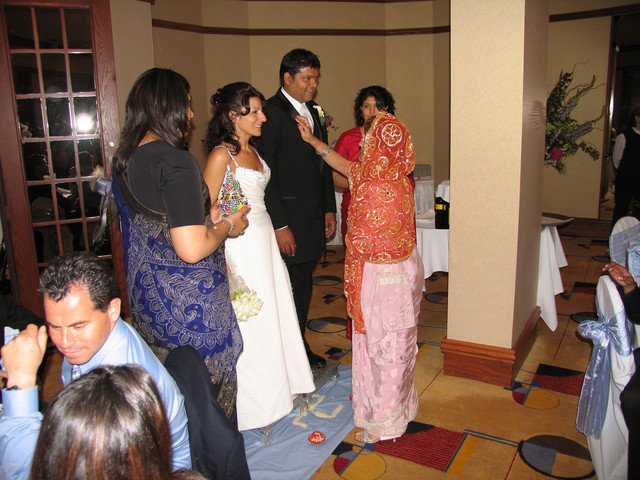
This picture shows Helena and Karim during their church wedding ceremony.

This picture shows Helena and Karim going through one of the Indian traditional wedding ceremonies.

A few days ago I was in rainy Vancouver to attend a very special wedding. It was the wedding of my nephew Karim. An Ismaili Muslim, born in Uganda and brought up in a cosmopolitan city of Vancouver. He was marrying Helena, a Catholic born in Portugal who was also brought up in the beautiful city of Vancouver. The love birds have been dating for the last two years. They got engaged a year ago.

I took my wife, my children and my mother with me. My mother lives in Calgary. She did not want to miss her grandson’s wedding. We flew from Calgary to Vancouver on a Thursday. It was a rainy Thursday.

This was a very special wedding because we have been waiting for Karim to get married for many years. We could not believe that the day had arrived. Karim’s parents had six children, including triplets. His parents came to Canada as refugees to run away from Idi Amin’s brutality in Uganda. Karim was a little boy then. As fate would have it, Karim’s mother missed the wedding. She passed away 10 years ago from pancreatic cancer. She was 60 years old.

Helena is a special lady. She is the only child of her parents. She is beautiful, youthful, vibrant, hard working and ambitious. Karim is tall, dark and handsome and they make a wonderful couple.

The wedding was planned to spread over three days. On Thursday night (the day we arrived) was a traditional mehndi (henna) ceremony. The ladies did not want to miss this. According to a web definition, henna is a coloring agent made from the green leaves of a henna plant which, when mixed with ingredients like tea, coffee, cloves, or tamarind, forms a paste. The tradition is popular in Middle East, North Africa and South Asia.

Saturday was the wedding day. The sun came out and it remained sunny for the rest of the day. The wedding took place in the afternoon at St. Augustine’s Parish. It was a good dignified wedding. Helena and Karim looked very beautiful and handsome. The families from both sides were present to witness the event. Many photographs were taken to record the event for their children and grandchildren.

The evening reception began with a traditional Indian wedding ceremony. This consists of several rituals to ward off evil and bring good luck, happiness, fertility and prosperity to the couple.

The food was excellent, a mix of eastern and western cuisines keeping in tune with the highly multicultural and multi-religious guests in the room. There were speeches, toasting, laughter and dancing until the early hours of the morning.

Karim spoke about his mother. How much he misses her. He was happy to see his grandma (now 88 years old) fly from Calgary and his older sister from Edmonton although both have to rely on wheelchairs to get around. That was very special.

Sunday was the last day to wind up the wedding ceremony. There was a family brunch and a visit to the cemetery to pay respects to Karim’s mom.

This wedding was a good example of what Canada stands for: peace and harmony among all faiths and all cultures. May Helena and Karim be blessed with a very long and happy life. With two Gods (so to speak) looking down on them, things cannot go wrong! Can they?

Start reading the preview of my book A Doctor's Journey for free on Amazon. Available on Kindle for $2.99!

More on Vitamin B12: Diagnosis and Treatment

My last column was on vitamin B12, also known as Cobalamin. Some of my colleagues said that I took a very simplistic approach to diagnosis and treatment of vitamin B12 deficiency. There is more to it than what my column implied.

In this column I will elaborate on the following two points: diagnosis and oral vs. injection treatment of B12 deficiency.

Is blood test a good way of confirming the diagnosis of B12 deficiency?

I discussed this point with Dr. Michael O’Connor, Medical Director of the Medicine Hat Regional Hospital Laboratories. He said there is a difference between the very common asymptomatic B12 deficiency and the much less common symptomatic and clinically apparent B12 deficiency. He says interpretation of low B12 result is hugely dependent on the clinical situation of that individual patient.

If the patient has symptoms of B12 deficiency (anaemia, neurological and psychiatric problems) and the blood results shows B12 to be low then the diagnosis of B12 deficiency is easy to make. If an individual has no symptoms then there is probably no role for screening for B12 deficiency, says Dr. O’Connor.

The process is difficult because there is lack of a diagnostic gold standard among the many available tests, there are too many patients with sub-clinical deficiency and there is decreased availability of reliable tests to identify the causes of a patient’s cobalamin deficiency, says an article in Hematology.

How to treat B12 deficiency: by oral pills or monthly injections?

I received the following information from the Medicine Hat Regional Hospital Pharmacy.

Either oral or injection formulations are effective for treating B12 deficiency.

The main mechanism of B12 absorption is via its binding of intrinsic factor in the stomach and its subsequent absorption in the intestine. Approximately 60 per cent of cobalamin is absorbed by this system. A secondary mechanism of its absorption does not require intrinsic factor and involves passive diffusion across the intestinal wall. When given orally only one per cent of a dose will be absorbed by this mechanism.

The daily requirement of cobalamin is 2-3mcg. Dosing with intramuscular or deep subcutaneous injections to treat deficiency involves 100mcg daily for five to 10 days, then 100-200mcg monthly until levels are normalized followed by 100mcg monthly for maintenance.

High oral doses in the range of 1000 to 2000mcg daily are just as effective for treating deficiency due to the secondary mechanism of absorption. Cobalamin can also be administered sublingually both safe and effectively (2000mcg). The benefit to sublingual cobalamin vs. oral is not well defined.

There are disadvantages to give patients regular injections of B12. They are: pain at the injection site, injection site reactions, inconvenience and higher cost due to the need for a health professional to administer the injection.

Despite these disadvantages injection treatment is still preferred for those patients who are unable to take medications orally, those who experience severe diarrhea or vomiting, those with compliance issues to a daily dosage regimen, as well as those with neurological symptoms.

Oral and sublingual cobalamin have no evidence of toxicity when used at high doses, are cost effective, less burdensome to the patient and are equally as efficacious when used at the appropriate doses as compared to injection dosage forms. The only disadvantage to choosing an oral or sublingual regimen is the potential for adherence issues. Hence oral cobalamin is an excellent option for treatment and prevention of mild to moderate cobalamin deficiency.

Start reading the preview of my book A Doctor's Journey for free on Amazon. Available on Kindle for $2.99!