
Dr. B Goes to Washington

Noorali in front of the White House
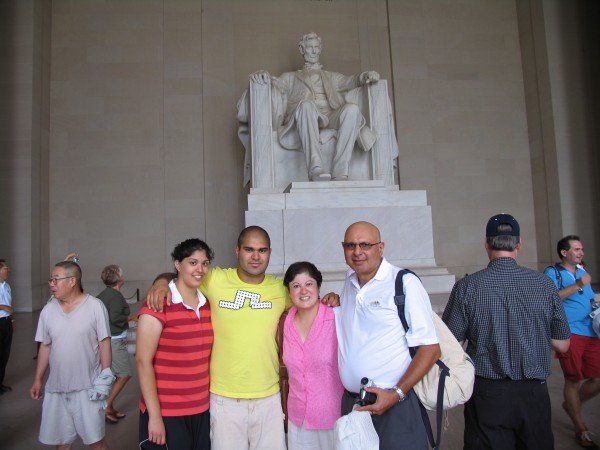

Alia, Hussein, Sabiya, and Noorali at Lincoln Memorial
Alia, Hussein, Sabiya and Noorali at Lincoln Memorial

I am back.

I feel good and refreshed after two weeks of a healthy holiday in Washington, DC, New York City, New York and Calgary, Alberta.

So what is so healthy about taking a holiday especially in those three busy cities? Isn’t traveling itself stressful these days?

Regular readers of my column may recall Leonardo da Vinci’s (1452-1519) quote which I often use in my holiday articles. It says, “Every now and then go away, have little relaxation, for when you come back to your work your judgement will be surer; since to remain constantly at work will cause you to lose power of judgement.”

We all have a busy lifestyle. We forget that we need time off for ourselves and for our families. As the Eddie Bauer ad says: Never confuse having a career with having a life. I always come back from holidays tired but relaxed, richer in experience and ready to go back to work with a fresh mind and a healthy attitude.

Traveling these days is stressful. But the price is worth paying for security and peace of mind. Only one segment of our trip was stressful. There is no direct flight from Calgary to Washington, DC. We flew by Air Canada to Toronto where we had to take another Air Canada connecting flight. We had to change planes, terminals and go through US immigration, customs and several security checks within one hour and 10 minutes.

We were lucky the plane did not leave without us. It took off several minutes late so we did not miss the connection. But our luggage did not make it. It arrived the next day. We felt very rushed, stressed and tired during the change over time.

Rest of the time in Washington was wonderful. The weather was nice and hot like Medicine Hat. People are very nice and friendly. We extensively used the Metro subway system and walked a lot. We do lot of walking on our holidays more than what we do in Medicine Hat. Our hotel was located in the Foggy Bottom Metro station area close to Georgetown and George Washington University.

There are several ways to see Washington. We used three methods: walking, Metro subway system and Tourmobile Sightseeing’s shuttle system (hop-on and hop-off). We had done some home work before leaving Medicine Hat. We had received maps and suggestion for three days/two nights ‘what to see’ itinerary from Washington, DC Convention and Tourism Corporation (www.washington.org).

The city is well organized and we were able to see a lot. We made stops at the White House, US Capitol, Union Station, Arlington National Cemetery, Lincoln Memorial (my favourite) and International Spy Museum. Smithsonian Institution has 15 fascinating museums. They are all free! We had time to see only two. There isn’t enough room to mention all the places we visited and every thing we did. But I was happy to visit Washington, DC and would like to go there and spend more time. I would not have said this a month ago.

Happiness is good for health and next week I will tell you about the enchanting New York City and the meaning of friendship which brought me so much happiness. Ciao.

Start reading the preview of my book A Doctor's Journey for free on Amazon. Available on Kindle for $2.99!

Re: One country, too many licensing bodies

Click here for link to original.

Re: One country, too many licensing bodies (Letter to editor, Canadian Medical Association Journal)

Written: July 25, 2006

I agree with the points raised by Stephen Sullivan in his letter published in CMAJ (CMAJ 2006; 175: 62).

I raised the same point 26 years ago in a letter to CMAJ (CMAJ, Vol. 132, May 15, 1985) where I expressed frustration experienced by foreign medical graduates (now called international medical graduates)when it came to dealing with numerous licensing bodies with selective and restrictive criteria to control the flow of doctors in their province.

Not much has changed in the last 26 years. I don’t think much is going to change in the next 26 years. I feel if a doctor has LMCC and one year of internship then he or she should be able to practice anywhere in Cananda.


Noorali Bharwani, FRCSC, FACS, General Surgeon, Medicine Hat, Alberta

Start reading the preview of my book A Doctor's Journey for free on Amazon. Available on Kindle for $2.99!

Points to Ponder

Stroke prevention:

Each year in Canada stroke occurs in 50,000 people and account for seven per cent of all deaths. About five per cent of men and women over the age of 65 have been affected by stroke. Patients with stroke require a lot of care and health care resources. The question is: can we prevent stroke?

Chronic conditions like atherosclerosis (hardening of the arteries), atrial fibrillation (irregular heart rhythm), hypertension, high cholesterol levels and diabetes can lead to stroke if not appropriately managed.

For example, about 26 per cent of Canadian adult men and 18 per cent of women have hypertension. But 40 per cent of such people are unaware they have hypertension. This is not good.

Some risk factors like age, gender and genetic factors cannot be changed. Physical inactivity, smoking and heavy use of alcohol increases the risk of stroke. These risk factors can be changed if a person so desires.

It is important to know the warning signs of stroke: sudden weakness, trouble speaking, sudden loss of vision and severe unusual headache or dizziness. If you do experience these symptoms then call for help. Timely use of aspirin and clot busting drugs can significantly modify the outcome of stroke.

According to an article in the Canadian Medical Association Journal, several agents can be used to manage underlying disease to prevent stroke:

-Antiplatelet agents like aspirin
-Blood thinners like Coumadin
-Control of high blood pressure with thiazides and ACE inhibitors
-Reducing the cholesterol level with statin
-If indicated, surgery for correction of narrowing of carotid artery in the neck

These measures should be combined with increased physical activity, no smoking and reduction in the amount of alcohol consumed. So stroke can be prevented if we take control of our health and modify the risk factors. See your doctor and find out what kind of risk factors you can modify to prevent stroke.

Germs in the work place:

“It turns out the typical office is a fertile breeding ground for germs – especially if you’re a teacher or an accountant,” says a news item in Stitches for Patients. A study conducted at the University of Arizona found that bacteria levels in accountants’ offices were almost seven times higher than in lawyers’ offices.

The study also found that phones, desks and keyboards used by teachers, accountants and bankers had two to 20 times more bacteria per square inch than other occupations. The more time you spend at your desk, the more germs you collect.

The American Dietetic Association has found that 20 per cent of American workers never clean their desks before eating on them and more than 75 per cent do so occasionally even though 57 per cent eat at their desks at least once a day.

What about the health conscious doctors? They were number five on the list of germiest offices, says the Stitches news item. Well, now I know where not to have my lunch! Honey, I am coming home.

Thought for the day from my friend George:

Never put both feet in your mouth at the same time because you won’t have a leg to stand on.

Start reading the preview of my book A Doctor's Journey for free on Amazon. Available on Kindle for $2.99!

Gastroparesis

Dear Dr. B: What is gastroparesis?

Answer: It is a condition in which the muscles in the wall of the stomach do not function normally. This leads to delayed gastric emptying. Patients complain about nausea and vomiting.

Most cases of gastroparesis are mild in nature. They respond to medications. According to an article in Tech-Wise, published by Alberta Heritage Foundation for Medical Research (www.ahfmr.ab.ca), about six to 10 people per 100,000 population have gastroparesis and do not respond to conventional treatment.

In severe cases of gastroparesis, patients have severe nausea, vomiting, pain, loss of appetite and weight loss. Vomiting usually occurs several hours after eating when the stomach is full of undigested food, stomach enzymes and acid. Patient’s nutrition is poor as the food does not reach the small intestine where digestion and absorption of food occurs.

Diagnosis of gastroparesis is difficult to make as nausea and vomiting can be symptoms of many conditions. Two most common investigations used to investigate gastroparesis are barium x-rays and endoscopy of the esophagus, stomach and duodenum. These tests are not always diagnostic but are important to rule out mechanical obstruction (cancer, ulcer, scarring and narrowing of the lumen) in the upper gastro-intestinal tract. Gastro-duodenal manometry is not available in all centers and is not necessary to make a diagnosis of gastroparesis.

What causes gastroparesis?

Most often the cause of gastroparesis is not known. According to Mayo Clinic website (www.mayoclinic.com) there are many precipitating factors like diabetes, surgery to upper gastro-intestinal tract, certain types of medications, cancer chemotherapy and other medical conditions like anorexia, bulimia, scleroderma, Parkinson’s disease, other nervous system illnesses and metabolic disorders such as hypothyroidism can lead to gastroparesis. Quite often it is not possible to find a cause of gastroparesis.

Is there a good treatment?

Currently there is no cure for gastroparesis. The first line of treatment to control symptoms is dietary changes (eat easily digestible food), medications to control vomiting and stimulate gastric emptying. These measures may not be effective in every case.

Researchers are investigating other types of therapies, including a stomach “pacemaker,” that eventually may prove more effective than current treatments for gastroparesis, says the Mayo Clinic website. This is called Enterra Therapy System (ETS). This new treatment is described and reviewed in Tech-Wise (June 2006). Here is the summary:

ETS is a neurostimulator that is implanted under the skin in the abdominal wall. It provides high frequency, low energy stimulation to the stomach wall through a pair of electrodes. The device is licensed in Canada for the treatment of chronic intractable nausea and vomiting.

The article reviewed six studies. Four studies showed at six to 12 months follow up there was significant symptomatic improvement after the device was implanted. Three studies showed improvement in nutritional status and two studies reported a significant improvement of quality of life.

The review article says that these improvements were not associated with improvement in gastric emptying. The device relieves symptoms of gastroparesis but how it does that is not known. Some authors speculate that it may be a placebo effect. The article says that the device is not for routine use in cases of gastroparesis. It should be used only as a last resort when other measures fail to relieve the symptoms.

Start reading the preview of my book A Doctor's Journey for free on Amazon. Available on Kindle for $2.99!