
A Beautiful Wedding

This picture shows Helena and Karim during their church wedding ceremony.
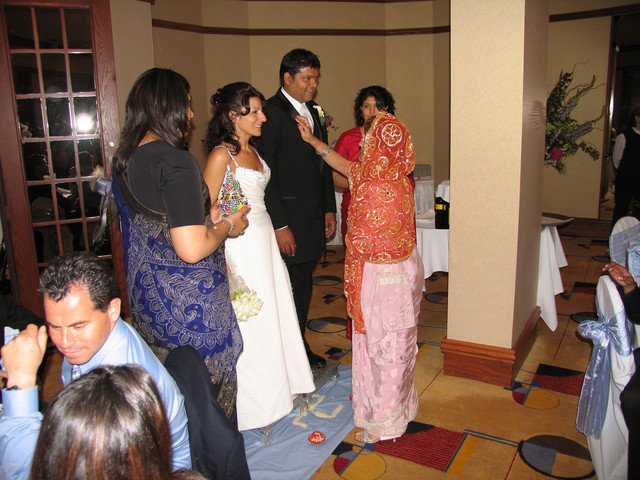
This picture shows Helena and Karim going through one of the Indian traditional wedding ceremonies.

A few days ago I was in rainy Vancouver to attend a very special wedding. It was the wedding of my nephew Karim. An Ismaili Muslim, born in Uganda and brought up in a cosmopolitan city of Vancouver. He was marrying Helena, a Catholic born in Portugal who was also brought up in the beautiful city of Vancouver. The love birds have been dating for the last two years. They got engaged a year ago.

I took my wife, my children and my mother with me. My mother lives in Calgary. She did not want to miss her grandson’s wedding. We flew from Calgary to Vancouver on a Thursday. It was a rainy Thursday.

This was a very special wedding because we have been waiting for Karim to get married for many years. We could not believe that the day had arrived. Karim’s parents had six children, including triplets. His parents came to Canada as refugees to run away from Idi Amin’s brutality in Uganda. Karim was a little boy then. As fate would have it, Karim’s mother missed the wedding. She passed away 10 years ago from pancreatic cancer. She was 60 years old.

Helena is a special lady. She is the only child of her parents. She is beautiful, youthful, vibrant, hard working and ambitious. Karim is tall, dark and handsome and they make a wonderful couple.

The wedding was planned to spread over three days. On Thursday night (the day we arrived) was a traditional mehndi (henna) ceremony. The ladies did not want to miss this. According to a web definition, henna is a coloring agent made from the green leaves of a henna plant which, when mixed with ingredients like tea, coffee, cloves, or tamarind, forms a paste. The tradition is popular in Middle East, North Africa and South Asia.

Saturday was the wedding day. The sun came out and it remained sunny for the rest of the day. The wedding took place in the afternoon at St. Augustine’s Parish. It was a good dignified wedding. Helena and Karim looked very beautiful and handsome. The families from both sides were present to witness the event. Many photographs were taken to record the event for their children and grandchildren.

The evening reception began with a traditional Indian wedding ceremony. This consists of several rituals to ward off evil and bring good luck, happiness, fertility and prosperity to the couple.

The food was excellent, a mix of eastern and western cuisines keeping in tune with the highly multicultural and multi-religious guests in the room. There were speeches, toasting, laughter and dancing until the early hours of the morning.

Karim spoke about his mother. How much he misses her. He was happy to see his grandma (now 88 years old) fly from Calgary and his older sister from Edmonton although both have to rely on wheelchairs to get around. That was very special.

Sunday was the last day to wind up the wedding ceremony. There was a family brunch and a visit to the cemetery to pay respects to Karim’s mom.

This wedding was a good example of what Canada stands for: peace and harmony among all faiths and all cultures. May Helena and Karim be blessed with a very long and happy life. With two Gods (so to speak) looking down on them, things cannot go wrong! Can they?

Start reading the preview of my book A Doctor's Journey for free on Amazon. Available on Kindle for $2.99!
More on Vitamin B12: Diagnosis and Treatment

My last column was on vitamin B12, also known as Cobalamin. Some of my colleagues said that I took a very simplistic approach to diagnosis and treatment of vitamin B12 deficiency. There is more to it than what my column implied.

In this column I will elaborate on the following two points: diagnosis and oral vs. injection treatment of B12 deficiency.

Is blood test a good way of confirming the diagnosis of B12 deficiency?

I discussed this point with Dr. Michael O’Connor, Medical Director of the Medicine Hat Regional Hospital Laboratories. He said there is a difference between the very common asymptomatic B12 deficiency and the much less common symptomatic and clinically apparent B12 deficiency. He says interpretation of low B12 result is hugely dependent on the clinical situation of that individual patient.

If the patient has symptoms of B12 deficiency (anaemia, neurological and psychiatric problems) and the blood results shows B12 to be low then the diagnosis of B12 deficiency is easy to make. If an individual has no symptoms then there is probably no role for screening for B12 deficiency, says Dr. O’Connor.

The process is difficult because there is lack of a diagnostic gold standard among the many available tests, there are too many patients with sub-clinical deficiency and there is decreased availability of reliable tests to identify the causes of a patient’s cobalamin deficiency, says an article in Hematology.

How to treat B12 deficiency: by oral pills or monthly injections?

I received the following information from the Medicine Hat Regional Hospital Pharmacy.

Either oral or injection formulations are effective for treating B12 deficiency.

The main mechanism of B12 absorption is via its binding of intrinsic factor in the stomach and its subsequent absorption in the intestine. Approximately 60 per cent of cobalamin is absorbed by this system. A secondary mechanism of its absorption does not require intrinsic factor and involves passive diffusion across the intestinal wall. When given orally only one per cent of a dose will be absorbed by this mechanism.

The daily requirement of cobalamin is 2-3mcg. Dosing with intramuscular or deep subcutaneous injections to treat deficiency involves 100mcg daily for five to 10 days, then 100-200mcg monthly until levels are normalized followed by 100mcg monthly for maintenance.

High oral doses in the range of 1000 to 2000mcg daily are just as effective for treating deficiency due to the secondary mechanism of absorption. Cobalamin can also be administered sublingually both safe and effectively (2000mcg). The benefit to sublingual cobalamin vs. oral is not well defined.

There are disadvantages to give patients regular injections of B12. They are: pain at the injection site, injection site reactions, inconvenience and higher cost due to the need for a health professional to administer the injection.

Despite these disadvantages injection treatment is still preferred for those patients who are unable to take medications orally, those who experience severe diarrhea or vomiting, those with compliance issues to a daily dosage regimen, as well as those with neurological symptoms.

Oral and sublingual cobalamin have no evidence of toxicity when used at high doses, are cost effective, less burdensome to the patient and are equally as efficacious when used at the appropriate doses as compared to injection dosage forms. The only disadvantage to choosing an oral or sublingual regimen is the potential for adherence issues. Hence oral cobalamin is an excellent option for treatment and prevention of mild to moderate cobalamin deficiency.

Start reading the preview of my book A Doctor's Journey for free on Amazon. Available on Kindle for $2.99!

Vitamin B12 Deficiency

Dear Dr. B: Can you please tell me about vitamin B12 deficiency?

Answer: This is a very important subject. I have written about this in the past. And it is worth repeating as 30 per cent of the adults older than 50 may have vitamin B12 deficiency. It is estimated up to 40 per cent of the general population may be deficient in this vitamin.

Vitamin B12, also known as cobalamin, was first isolated in 1948 and was immediately shown to be effective in the treatment of pernicious anaemia. Pernicious anaemia is a fairly common condition in which the stomach does not have enough acid and does not make intrinsic factor normally. Intrinsic factor is essential for the absorption of B12 in the stomach.

Absorption of B12 is also impaired in individuals who have had intestinal illness or intestinal surgery, which makes it hard for the intestines to absorb vitamin B12. Absorption of vitamin B12 from foods is complex. A defect in any step can lead to deficiency.

B12 is obtained primarily from animal proteins (red meat, poultry, fish, eggs, and dairy). But the vegetarians can get enough of it from legumes. The cause of B12 deficiency is not usually poor diet but problems with absorption as explained earlier.

Our body needs vitamin B12 to make blood cells. Persons with the deficiency may have no symptoms or may have symptoms related to blood disorder or disorders of the nervous system including psychiatric problems. Fatigue may be one of the first indications of B12 deficiency.

The liver stores most of the body’s B12 followed by the kidneys, heart, spleen, and brain. The stored B12 can last up to two years in conditions where our body is deprived of B12.

The diagnoses of B12 deficiency is made by checking the blood levels in patients who have symptoms or who are prone to B12 deficiency. Screening for B12 deficiency (by way of a blood test) is recommended in the following groups of people:

-all elderly patients who are malnourished
-all patients in institutions and psychiatric hospitals
-all patients who have blood disorders, neurological or psychiatric problems.

Treatment is by B12 injections on regular basis for the rest of person’s life.

*********

The golf season has started. It’s time to have little fun here before we get miserable on the golf course. Here is a joke from Golf Digest:

A man is stranded for years on a desert island. One day he looks up to see a gorgeous blond in scuba gear wading out of the water.

“Want a cigarette?” she asks, opening a waterproof pocket on her right arm, pulling out a pack and lighting one for him.

“How about a sip of whiskey?” she asks next, opening a pocket on her left arm and removing a flask.

As the man puffs on the cigarette and sips the whiskey, she slowly begins to unzip the front of her wet suit.

“Want to play around?” she asks.

And he says, “Oh, Lord, don’t tell me you’ve got a set of golf clubs in there, too.”

Start reading the preview of my book A Doctor's Journey for free on Amazon. Available on Kindle for $2.99!

Nurses Week: Florence Nightingale

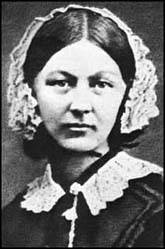
Florence Nightingale

Florence Nightingale (May 12, 1820 – August 13, 1910)

‘The very first requirement in a hospital is that it should do the sick no harm.’ -Florence Nightingale 1820-1910

National Nursing Week is being celebrated from May 8-14, 2006. The week is organized around Florence Nightingale’s birthday on May 12. This year’s theme for National Nursing Week is Nursing: Promoting Healthy Choices for Healthy Living.

Nursing was fully established as a profession in the nineteenth and twentieth centuries. But nursing is an old profession and in India, hundreds of years before Christ, a nurse’s qualifications were described as follows (Lyons and Petrucelli’s Medicine, An Illustrated History):

-Knowledge of the manner in which drugs should be prepared or compounded for administration
-Cleverness
-Devotion to the patient waited upon
-Purity of mind and body

A nurse can either be a man or a woman. Throughout history males have attended to the sick in hospitals. But women have been the principal performers of nursing duties in every period and every country.

Who was Florence Nightingale?

William Nightingale of Embly Park, Hampshire, U.K. was a wealthy landowner. His daughter Florence was born in Florence, Italy. Florence was taught by her father. She learnt many languages and studied history, philosophy and mathematics.

Florence’s mother, Fanny, wanted Florence married at an early age. But Florence refused to do that. At the age of 25, Florence decided to be a nurse. The profession of nursing was looked down upon during that time so her parents were not very happy with Florence’s decision.

At the age of 31, Florence went to Kaiserwerth, Germany to study nursing and two years later returned to England to be appointed as lady superintendent of a hospital in London.

In 1853, the Crimean War started when Russia invaded Turkey. Britain got involved and sent troops to Turkey to stop the spread of Russian influence in that area. Very soon the British troops were down with cholera and malaria. Florence Nightingale offered her services and took a group of 38 nurses to Turkey.

There was considerable prejudice against women medical personnel in general and especially in the army. Nightingale had difficult time being accepted but she fought hard to reform the army hospitals where there was lack of hygiene and elementary care.

In 1856, Nightingale returned to England. She was treated as a national heroine. She launched a campaign to improve the quality of nursing in military hospitals; she published books on nursing reforms and in 1860, found the Nightingale School & Home for Nurses at St. Thomas’s Hospital. She also campaigned for the emancipation of women. Nightingale was also acknowledged as a “prophetess” in the development of applied statistics.

Nurses have come a long way since the days of Florence Nightingale. Now some of the nurses will be working as nurse practitioners. A recent article in the Canadian Medical Association Journal says that all the provinces and two territories have passed legislature which allows nurse practitioners to work.

A nurse practitioner is a registered nurse with additional education in health assessment, diagnosis, treatment and management of illnesses and injuries. In 2004, there were 878 licensed nurse practitioners in Canada. And this number is increasing.

Nurses are part and parcel of our health care system and their role will continue to increase as they continue to take advantage of higher education and the gaps left by the shortage of physicians in rural areas. I have worked with nurses all my working life and have been on the receiving end of their kindness and care as a patient. I admire the hard work they do. Good luck and keep up the good work. Enjoy the National Nursing Week.

Start reading the preview of my book A Doctor's Journey for free on Amazon. Available on Kindle for $2.99!