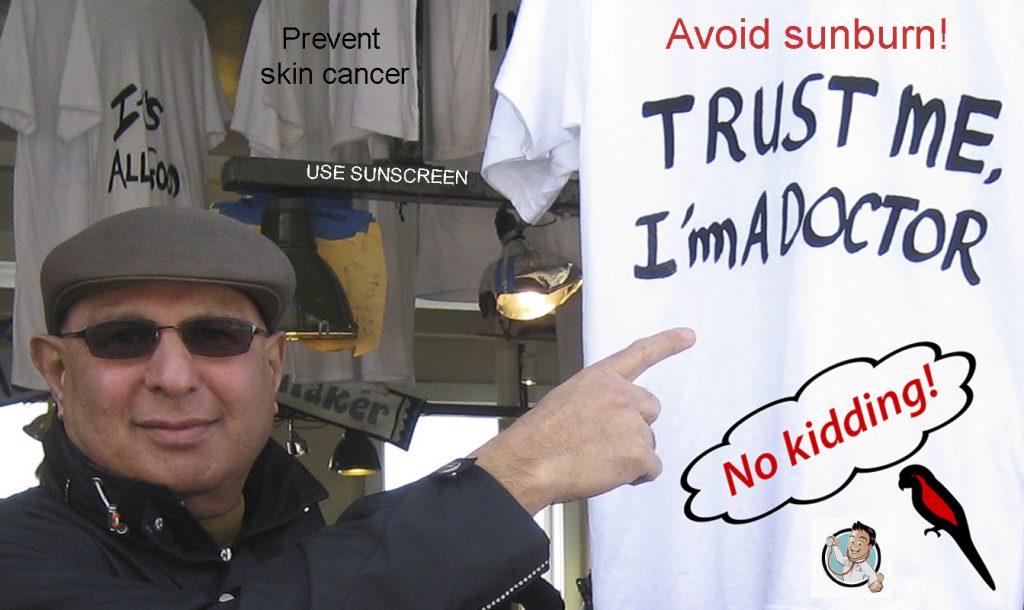
Proper Use of Sunscreen Important to Prevent Skin Cancer

"Trust me, I'm a doctor!" (Dr. Noorali Bharwani)

Skin cancer is the most common cancer in North America. The benefits of sunscreen outweigh the inconvenience of using it.

First step in the prevention against skin cancer is to avoid sun exposure between 10 a.m. and 2 p.m. whatever the season. These are prime hours for exposure to skin-damaging ultraviolet (UV) radiation from the sun, even on overcast days.

Second step is to wear protective clothing. This includes pants, shirts with long sleeves, sunglasses and a wide-brimmed hat.

Third step is to use sunscreen. Apply sunscreen generously and reapply regularly, says a dermatologist at Mayo Clinic.

There are two types of UV light that can harm your skin – UVA and UVB. A broad-spectrum sunscreen protects you from both.

UVA rays can prematurely age your skin, causing wrinkles. UVB rays can burn your skin. Too much exposure to UVA or UVB rays can cause skin cancer. The best sunscreen offers protection from all UV light.

SPF stands for sun protection factor, a measure of how well sunscreen protects against UVB rays. UVA protection isn’t rated. Manufacturers calculate SPF based on how long it takes to sunburn skin that’s been treated with the sunscreen as compared to skin with no sunscreen.

When applied correctly, a sunscreen with an SPF of 30 will provide slightly more protection from UVB rays than does a sunscreen with an SPF of 15. But the SPF 30 product isn’t twice as protective as the SPF 15 product. Sunscreens with SPFs greater than 50 provide only a small increase in UV protection.

Often sunscreen is not applied thoroughly or thickly enough, and it can be washed off during swimming or sweating. As a result, even the best sunscreen might be less effective than the SPF number suggests.

Rather than looking at a sunscreen’s SPF, choose a broad-spectrum sunscreen. A water-resistant sunscreen means the SPF is maintained for up to 40 minutes while swimming or sweating. Very water resistant means the SPF is maintained for 80 minutes.

Is one sunscreen better than others?

Experts at Consumer Report (May 2017) tested 62 lotions, sprays, sticks, and lip balms. Out of these, 23 tested at less than half their labeled SPF number. That doesn’t mean the products aren’t protective, but you may not be getting the degree of protection you think you are.

To compare the full list of sunscreens you will have to go to the Consumer Report. Here are the top five brands mentioned in the Report:

  1. Equate Sport Lotion SPF 50 (Walmart)
  2. Pure Sun Defense Lotion SPF 50
  3. Equate Ultra Protection Lotion SPF 50 (Walmart)
  4. Trader Joes Spray SPF 50+
  5. Equate Sport Continuous Spray SPF 30 (Walmart)

If you cannot find one of the above sunscreens, then choose a chemical sunscreen with an SPF of 40 or higher that will give you a better chance of getting at least SPF 30.

How to use the sunscreen?

  1. Shake it well.
  2. Apply 15 to 30 minutes before going out.
  3. Use at least a teaspoon on each body part.
  4. Reapply every two hours.
  5. Use spray sunscreens carefully so you don’t inhale it, they can also be flammable. Avoid using sprays on children.

Be safe and enjoy the summer.

Start reading the preview of my book A Doctor's Journey for free on Amazon. Available on Kindle for $2.99!

Vitamin D and Respiratory Infections

A walk on the beach in Maui. (Dr. Noorali Bharwani)

A research article in the British Medical Journal (BMJ February 15, 2017) says vitamin D supplementation is safe and it protects you against acute respiratory tract infection.

The object of the study was to assess the overall effect of vitamin D supplementation on risk of acute respiratory tract infection, and to identify factors modifying this effect.

The researchers looked at the results of 25 eligible randomized controlled trials (total 11,321 participants, aged 0 to 95 years).

They found vitamin D supplementation reduced the risk of acute respiratory tract infection among all participants.

The article says acute respiratory tract infections are a major cause of global morbidity and mortality and are responsible for 10 per cent of ambulatory and emergency department visits in the USA and an estimated 2.65 million deaths worldwide in 2013.

Vitamin D deficiency is associated with many conditions, including bone loss, kidney disease, lung disorders, diabetes, stomach and intestine problems, and heart disease. Vitamin D supplementation has been found to help prevent or treat vitamin D deficiency.

Vitamin D, often called the sunshine vitamin, is mainly obtained from sun exposure of our skin. However, Canadians are not getting enough of sunshine vitamins. Supplements are necessary to obtain adequate levels because a person’s diet has minimal impact, says Osteoporosis Canada website (New Vitamins D Guidelines 2010).

“Canadians are at risk of vitamin D deficiency from October to April because winter sunlight in northern latitudes does not allow for adequate vitamin D production,” says Julie Foley, president & CEO of Osteoporosis Canada. She goes on to say that because vitamin D requirements for an individual may vary considerably depending on many factors, it’s very important to check with your physician about how much vitamin D you should be taking.

Vitamin D is essential to the treatment of osteoporosis because it promotes calcium absorption from the diet and is necessary for normal bone growth. Some research suggests it may also ward off immune diseases, infection and cancer.

How much vitamin D should you take each day?

The new guidelines recommend daily supplements of vitamin D 400 to 1000 IU for adults under age 50 without osteoporosis or conditions affecting vitamin D absorption. For adults over 50, supplements of between 800 and 2000 IU are recommended.

Coming back to our topic – Do vitamin D supplements help prevent respiratory tract infections?

An editorial comment in the British Medical Journal (15 February 2017) says clinically useful effect of vitamin D on respiratory infection remains uncertain despite hints in the new analysis mentioned earlier in this column.

The editorial goes on to say, “Eight trial level meta-analyses have examined this topic since 2012, with conflicting findings: three reported benefits and five no consistent benefits.” The editorial conclusion is… we need more trials to prove the point that vitamin D supplements protect against respiratory infection.

In the meantime there is no reason to avoid taking vitamin D everyday as indicated earlier. There is no doubt vitamin D is required for many more reasons than just preventing lung infection.

Start reading the preview of my book A Doctor's Journey for free on Amazon. Available on Kindle for $2.99!

Painkiller Use in Seniors with Non-Cancer Pain

Relaxation in Maui. (Dr. Noorali Bharwani)

An article in a newsletter published by the College of Physicians and Surgeons of Alberta (May 1, 2017) provides guidelines to physicians on safe prescribing of painkillers to seniors with non-cancer pain.

The article uses an example of John, a 78-year-old man who has experienced chronic low-back pain due to arthritis for several years, with gradual worsening over time. There is no indication John needs surgery.

John has several medical conditions that include mild cognitive impairment (problems with memory, language, thinking and judgment), high blood pressure, diabetes mellitus type 2, mild chronic renal impairment and falls.

His current medication regimen includes acetaminophen 500 milligrams (mg) when needed and naproxen 200 mg twice daily (over the counter supply). These painkillers do not relieve his pain. He wants a stronger medication.

As we know chronic pain is common in older adults. There are concerns regarding the potential adverse effects of painkillers in this population. But should we let them suffer? No. A person should be treated as a whole taking into consideration other medical problems.

Management of John’s pain includes appropriate assessment of the pain and other medical issues. That should include involvement of John’s family in the future management plan.

The article says, “Treatment-related goals should generally be directed toward improvements in function rather than in pain intensity as function-related goals are often more evident in patients with chronic pain.”

What kind of painkillers can we use safely?

Acetaminophen is the first line of treatment for older adults with mild-to-moderate pain. Acetaminophen at recommended doses is considered safe. Maximum recommended daily dose is 3,000 mg. Dose is lower if a person has liver disease or those who consume three or more alcoholic beverages daily. Acetaminophen should not be used if a person has severe liver failure.

Oral NSAIDs (non-steroidal anti-inflammatory drugs) are recommended to be used with caution and for the shortest time possible. This recommendation stems from the high risk of side effects, particularly with long-term use. It can adversely affect the stomach, heart and kidneys.

Topical NSAIDs, such as diclofenac gel, are generally preferred for localized musculoskeletal pain such as osteoarthritis.

Opioids (produces morphine like effect) use in older adults with chronic non-cancer pain has been associated with decreased pain intensity and improved function. However, there is a lack of data on long-term efficacy as existing studies have been only short-term. It is a narcotic and can cause confusion, increased risk of falls, fractures, hospitalization and mortality.

For mild to moderate pain, the recommendation is to use codeine or tramadol. Second-line opioid treatment for mild-to-moderate pain, and first-line for severe pain is morphineoxycodone or hydromorphone.

Antidepressants should be used in patients who have co-existing depression and pain.

Non-pharmacologic Management

This involves a psychologists and a social worker. They can be helpful in terms of teaching coping strategies, providing emotional support and accessing appropriate programs. A physiotherapist can help with flexibility, balance and endurance exercises.

Pain management in the elderly with multiple medical conditions is not easy but a team effort can do a lot to help and relieve suffering.

Start reading the preview of my book A Doctor's Journey for free on Amazon. Available on Kindle for $2.99!

Primary Progressive Aphasia

Casa Batlló, a building designed by Gaudí in Barcelona. (Dr. Noorali Bharwani)

Primary progressive aphasia is a rare nervous system syndrome. It is an acquired condition that affects a person’s ability to communicate.

An aphasic person cannot express himself or herself when speaking, has trouble understanding speech, and has difficulty with reading and writing or finding words.

Brain damage causes aphasia. This quite often happens after a stroke or head injury. It can happen if a person has a brain tumour or Alzheimer’s disease. It is important to remember primary progressive aphasia is not Alzheimer’s disease. In primary progressive aphasia the problem is a disorder of language with preservation of other mental functions of daily living for at least two years. Symptoms may get worse after that.

The effects of aphasia differ from person to person and can sometimes be eased by speech therapy. Most people affected by this condition can maintain ability to take care of themselves and pursue hobbies. In some instances a person can remain employed.

Primary progressive aphasia may present in a number of different ways but it commonly appears initially as a disorder of speech, progressing to a near total inability to speak in its most severe stage, while comprehension remains relatively preserved.

Symptoms begin gradually, often before age 65, and worsen over time. People with primary progressive aphasia have a difficult road ahead. They are fighting against a condition in which they will continue to lose their ability to speak, read, write, and/or understand what they hear. The illness progresses slowly.

Medically speaking, primary progressive aphasia is caused by a shrinking of the frontal, temporal or parietal lobes in the brain, primarily on the left side. The condition affects the language centers in the brain.

Who is at a higher risk of being affected by primary progressive aphasia? A person having learning disabilities and a person who has certain gene mutations – meaning that it may run in the family.

An individual who has aphasia should carry an identification card and obtain materials available from the National Aphasia Association (www.aphasia.org). This helps in communicating about the person’s condition to others.

Unfortunately, people with primary progressive aphasia eventually lose the ability to speak and write, and to understand written and spoken language. As the disease progresses, other mental skills, such as memory, can become impaired. Some people develop other neurological conditions. With these complications, the affected person eventually will need help with day-to-day care.

People with primary progressive aphasia can also develop behavioral or social problems as the disease progresses, such as anxiety or irritability. Other problems might include blunted emotions, poor judgment or inappropriate social behavior.

The diagnosis of the condition is based on history of worsening communication skills, changes in thinking and behaviour over one to two years. Besides physical examination a doctor will order several test including blood tests, speech and language tests, genetic tests, MRI, etc.

Unfortunately, primary progressive aphasia cannot be cured, and there are no medications to treat it. The good news is, some therapies, like speech and language therapy, may help improve or maintain the ability to communicate and manage the condition.

Start reading the preview of my book A Doctor's Journey for free on Amazon. Available on Kindle for $2.99!