Testicular Cancer In a Nutshell

Two things happened recently: a local celebrity went public about his recent encounter with testicular cancer and a pamphlet, published by the Canadian Testicular Cancer Association (TCTCA), arrived in my mail box. I thought it was a good topic to discuss and put the subject in a nutshell (no pun intended).

Testicular cancer is rare but it is the most common cancer in young men between the ages of 15-35, says the TCTCA pamphlet. A young man has a one-in-300 chance of developing it sometime in his life. In the last 30 years, rates in Ontario have increased by 60 per cent. The incidence of this disease has been increasing in developed countries throughout the world for several decades. We should not forget that testicular cancer can occur in older men as well.

According to a document released by Alberta Cancer Board (Cancer in Alberta: A Regional Picture 2007) the incidence of cancer of male genital organs (testicles, scrotum and penis) in 2004, excluding prostate cancer, was 8.2 per 100,000 population. Total number of cases was 124 for all three male genital organs compared to prostate cancer the total number was 1986 (138.8 per 100,000 population). The document does not give a separate figure for testicular cancer. But these statistics give you an idea that the number of testicular cancer is not very high.

Who gets testicular cancer?

There are several risk factors. These are: delayed drop of the testicles into the scrotum at birth, a family history of testicular cancer, abnormal testicular development, some rare genetic condition or one testicle is significantly smaller than the other. But some men get the disease with none of these risk factors.

Early detection of cancer is important. And this can be done by self-examination after a hot shower when the scrotum is completely relaxed. Check for any swelling on the scrotum. Examination of the testicles should not be painful. You should feel the size and weight of each testicle. It is common for one testicle to be slightly bigger than the other and one may hang lower than the other. Examine yourself at least once a month.

What are the signs and symptoms of testicular cancer?

If you notice any change in size, shape or consistency of the testicle then you should talk to your doctor. Quite often (but not always) there is a painless hard lump. You should be concerned if there is any swelling or pain in the scrotum, if you notice any heaviness or dragging in the lower abdomen or scrotum or a dull ache in the lower abdomen and groin, unusual backache that doesn’t go away or you have unexplained weight loss. Any soreness or sudden unexplained enlargement of the breast should be checked out. It could be secondary to testicular cancer. TCTCA warns that some males get testicular cancer without any of these signs or symptoms.

First line of investigation for a suspected lump in the scrotum is an ultrasound. If cancer is suspected then additional blood tests are done to look for tumour markers. The tumour markers for testicular cancer are AFP (alpha-fetoprotein), beta-HCG (beta-human chorionic gonadotropin) and LDH (lactate dehydrogenase).

A definitive diagnosis of testicular cancer is made by removing the testicle and sending it for biopsy. Then the cancer is checked for any spread to lymph glands or other organs. Treatment may include surgery, radiation therapy or chemotherapy. The cure rate for testicular cancer is greater than 90 per cent for all stages. In men, whose cancer is diagnosed in an early stage, the cure rate is nearly 100 per cent. Even those with advanced disease have a cure rate of greater than 80 per cent.

For more information visit: www.tctca.org.

Start reading the preview of my book A Doctor's Journey for free on Amazon. Available on Kindle for $2.99!
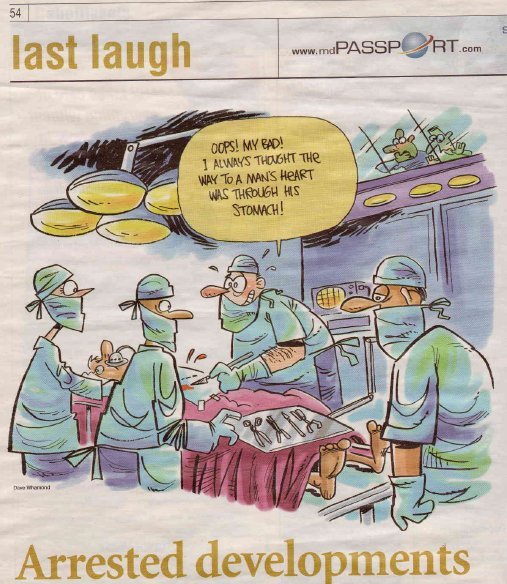
Last Laugh: Arrested Developments

Dr. Noorali Bharwani comes to the awkward conclusion that as a surgeon he has certain skills but as for the general doctoring skills others seemed to have-uh, not so much.

Cartoon from article in Medical Post.


When it comes to cardiac arrest, we, the surgeons, do not get any respect.

When it comes to severe trauma, a general surgeon is expected to be “captain of the ship” and take command of resuscitation and stabilization of the patient. This is because we know the first three letters of the alphabet: ABC (airway, breathing and circulation).

When I was a general surgical resident, I was not part of the cardiac arrest team. I confess, beyond ABC, I have difficulty remembering what to inject and where to inject drugs during cardiac arrest. Should they be given subcutaneously, intravenously or intra-cardiac? What does the ECG say? I can read a flat line (by that time it is too late anyway) but I would have trouble interpreting anything else.

I am not totally useless. I can intubate a patient, perform a tracheotomy, do a cut down on a vein and place an arterial line. Beyond that my medical knowledge is not that strong.

I was beginning to develop a complex. I was jealous of the internal medicine residents who acted so smart. Their white coat pockets bulged with concise pocket guidebooks, hammer, tuning fork, flashlight, different coloured pens and a stethoscope hanging down their necks. They would know the precise dosage of medications and would know exactly what to give at what stage of the cardiac arrest.

In order to regain my confidence and self-esteem, I decided to do three months’ elective in ICU as part of my surgical residency program.

Word of my limited knowledge of cardio-respiratory medicine must have reached the medical staff of ICU because the only procedures I was assigned to do were tracheotomies, intubations, cut-downs for venous excess and insertion of an arterial line.

This further exasperated my frustration and low personal esteem. It did not get any better when I went into practice. One day, I had done a right hemicolectomy on an elderly patient. Within the first couple of days after surgery, he developed severe chest pain and went into cardiac arrest. This was about two in the morning. The nurse phoned me to say the cardiac arrest team was there to resuscitate the patient and she was letting me know what was going on. She said the ER physician was dealing with the cardiac arrest.

I felt guilty that I wasn’t there to be “captain of the ship” and save my patient’s life. By the time I dressed and rushed to the hospital the patient had died. I could see the straight line on the ECG, the pupils were fixed and dilated, he was not responding to painful stimuli, he had no heart or breath sounds. Like a true captain I called off the resuscitation process.

Last summer, I was on a transatlantic flight with my family. I was trying to relax with soft jazz music beaming through my earphones. Suddenly the music stopped and I heard the captain say: “This is the captain speaking. Is there is a doctor or a nurse on board? Please identify yourself.”

I was reluctant to identify myself knowing my limited capacity when dealing with medical problems. At the request of my family, and not wanting my children to see me being a wuss, I pressed the overhead button. The air hostess came.

“I am a surgeon. Is there anything I can do to help?” I asked.

“Oh, don’t worry,” she said. “We don’t think the lady needs any surgery. She is having chest pain and is short of breath. We found a nurse. She is managing the case quite well.”

Although I was relieved to hear everything was going well without my services, I wondered what would have happened if my services were needed. Would I have failed to save somebody’s life?

That question weighed heavily on my chest (no pun intended). I started to get nightmares. In my sleep, I would recite the protocol of managing cardiac arrest. One night, my wife shook me and woke me up. Apparently, I was trying to give her mouth-to-mouth resuscitation while massaging her chest. She said I had been doing that every night since we got back from our holidays. Except, this time I was getting a little too excited!

“Honey, you don’t have to be that rough. If you want something then just ask nicely,” she said.

Why didn’t she say that before?

Start reading the preview of my book A Doctor's Journey for free on Amazon. Available on Kindle for $2.99!

The Beauty and The Beast of Sun Exposure

Once again, it is time to remind ourselves that exposure to sun’s rays can be healthy and harmful. They can make us look good and make us feel healthy. They can also damage our skin and can even kill us. There are more than 25 human disorders that are either caused by or aggravated by exposure of the skin to sunlight. But exposure to sunlight is also the most potent and natural way to manufacture vitamin D in our body.

Now, did you ever think that exposure to sunlight can be lethal?

When the skin is exposed to ultraviolet radiation, there is immediate increase in the number of melanocytes and production of melanin pigment. This results in tanning. The amount of melanin produced is genetically determined. That is why some people burn easily without tanning. Melanin also acts as a filter to decrease the harmful effects of ultraviolet rays to the dermis.

The reason people want to tan is to look like me – just kidding! The real reason is they want to look good. They think tanning is healthy. Somehow a tanned person looks healthier if it is not overdone. That is if you haven’t baked yourself.

But the beastly thing is melanoma arises from melanocytes, the very cells which give us a false sense of looking good. Melanoma is a skin cancer if not treated early can be lethal. The death rate from melanoma continues to rise about two per cent annually.

There are two other skin cancers which do not kill but can cause local disfigurement if not treated. These are: basal cell and squamous cell cancers. The risk of skin cancer is increased in individuals who spend too much time outdoors; children who have had episodic sunburn, and if there is a family or personal history of skin cancer (especially melanoma).

What is interesting is, despite having a good understanding of the relation between overexposure to the sun and skin cancer, 81per cent of North Americans still think they look good after being in the sun.

There are indeed benefits to exposing your skin to the sunrays in moderation before 10 a.m. and after four in the afternoon. When the skin is exposed to sun’s ultraviolet rays the skin makes vitamin D, which is rapidly absorbed in the blood and can be stored for several months, mostly in the blood and fat tissue.

We have always known vitamin D is needed for good health and strong bones and teeth. In the last few months, several reports have appeared which advance the case for universal intake of vitamin D on a daily basis to prevent certain types of cancer.

Increased intake of vitamin D helps prevent falls in the elderly. A report in the journal Nutrition Reviews suggests that adults should daily take 2,000 IU of vitamin D to help prevent some cancers. The Canadian Cancer Society is now recommended taking 1,000 IU of vitamin D daily as a cancer prevention step. Experts suggest taking supplements of no more than 2,000 IU per day.

Have you started taking vitamin D yet?

If not, then you need to spend some time out in the sun for your body to manufacture enough vitamin D to last you through the winter. But care and moderation is required. Avoid prolonged exposure, wear protective clothing, and use a sunscreen with a SPF of 15 or higher. To protect the eyes wear good quality sunglasses which block ultraviolet rays.

So, enjoy the summer carefully, if and when it arrives.

Start reading the preview of my book A Doctor's Journey for free on Amazon. Available on Kindle for $2.99!

Killer Foods

Recently, a friend said to me, “As I get older, I am expending fewer calories each day. I find my taste buds demand that I eat food heavy in calories, such as fried foods and delicious sweets. I find that my abdominal girth is rapidly (I wish I can say slowly) expanding. I feel I have completely lost control of my diet, weight and girth. What do you suggest I do to get control of my health?”

Answer to a question like this is usually simple, “Eat less and exercise more.”

What most of us do is, exercise and eat carefully for a few months. We get fit, we look good, and we feel healthy and then we become lax. The enthusiasm and the challenge of losing weight run out. We get busy with other things. Then suddenly the clothes do not fit. We get frustrated and depressed. And we start the cycle all over again.

It’s no rocket science to remember that regular exercise, healthy eating and counting calories is a must for staying healthy. Thirty to 60 minutes of daily exercise makes you feel better and helps improve and maintain your health. It does not matter what kind of exercise you do or whether you do all at one time. You can exercise 10 minutes three to six times a day. Important thing is to keep doing something.

Eating healthy and eating less poses the same sort of challenge as doing regular exercise. You should establish certain routine in how you eat and what you eat. Eating slowly and chewing well helps. Cooking and eating at home is better than eating at a restaurant or picking up fast food at lunch or on your way home after work. Eating out means consuming about 30 per cent more calories than you would normally do when you eat at home.

Fruits and vegetables in your diet is a must. Follow Canada’s Food Guide available at Health Canada web site, Health Unit or your dietitian. Make a list of dangerous and what I call killer foods which you should avoid at all cost – these are foods which we commonly eat but are dangerous to our health. My short list of killer foods includes French fries, bagels, croissants, donuts, double cheese burgers, fried fast food chicken, and ice-cream.

Let me tell you little bit about French fries. Potatoes have been around for about 200 years. French fries have been around for about 150 years. The first chip fried in Britain was in 1860 and first sold by a Belgium immigrant in 1870. Who invented the French fry? The honour goes to Belgians.

Only in North America we use the term French fry. In Britain they are called “chips” and in Belgium they are called “patat” and in France “pommes frited” which literally means fried apples. French fries have nothing to do with France. But the name is stuck because the Americans think it started in France.

An average size boiled potato has about 100 calories. If it is sliced and deep fried then naturally the calories almost double. Then you add Ketchup, sour cream, bacon bits or some other sauce, the calories almost triple. Next time you get a serving of French fries, guess how many potatoes have been sliced for that serving and then do your math. To me, eating French fries is like smoking a cigarette, they are both lethal.

In Canada and U.S., 25 per cent of the vegetables consumed are prepared as French fries. This has resulted in widespread obesity. French fries are loaded with saturated fat and trans fat. These are very dangerous substances and can cause blood vessel and heart diseases.

Space does not allow me to detail other killer foods. But you get the point.

Start reading the preview of my book A Doctor's Journey for free on Amazon. Available on Kindle for $2.99!