Breast Lumps Should Not Be Ignored

Breast lumps are very common. Breast lumps appear in women and men. They may appear in children. But mostly the breast lumps appear in adults. A breast lump is always an important clinical finding – never to be ignored. It is also a source of anxiety for the patient and his or her family. The first thing they want to know is, “Doctor, is this cancer?”

Investigations of a breast lump starts with a history and physical examination. Physical examination is best done between seven to 10 days from the first day of the menstrual cycle. The clinical history will establish how long the lump has been present. Whether there has been any change. And if there is a previous history of breast biopsy or breast cancer.

Risk factors for breast cancer will be noted (patient’s age and family history). It is important to remember, absence of risk factors does not decrease the probability of cancer.

Careful examination of the breasts will confirm the presence and establish the character of the lump. Hard, irregular, tethered, fixed or painless lump may be suggestive of cancer. Axillary (armpit) and neck areas are checked for lymph glands. The predictive value of physical examination (to say whether the lump is benign or malignant) in experienced hands is about 75 percent.

Mammograms in younger women are not very helpful. But after mid-30s the value of mammography increases. Quite often mammography can clarify the nature of the lump. It can also detect non-palpable lumps.

The overall level of sensitivity of mammography in palpable breast cancers may be no more than 82 percent. It may be even lower in premenopausal women. A negative mammogram in the presence of a persistent lump does not exclude malignancy.

Fine-needle aspiration biopsy done in the office can establish whether a breast lump is solid or cystic. When the lump is solid, cells can be aspirated for examination under a microscope. If fluid is obtained during aspiration and the lump disappears then it is a cyst.

In a cystic lump, if the fluid is not bloody then no specimen needs to be sent for examination and no further investigation is necessary. Bloody fluid may be suggestive of cancer and should be sent for microscopic examination.

Fine-needle aspiration biopsy should provide satisfactory specimen for microscopic examination in 90 percent of the cases with an accuracy rate of 95 percent to detect presence of cancer cells.

When physical examination, mammography, and microscopic examination of aspirated specimen indicate cancer then the probability of this being confirmed by surgery is more than 99 percent. If all three tests are negative then the lump being cancerous is less than one percent.

Core-biopsy, where a bigger sample (a core of tissue) is taken from a breast lump, has 90 percent predictive value for breast cancer. A negative biopsy may make it unnecessary to do an open surgical biopsy.

Ultrasound of the breast lump is an alternative method to distinguish a cyst from a solid lump. Ultrasound is useful when a non-palpable lump is seen on a mammogram.

Nuclear medicine techniques (Miraluma scan) have been used to evaluate breast cancer. Its predictive value for cancer is around 80 percent for a palpable lesion and 50 to 70 percent for a non-palpable breast lump found on mammography.

Whenever reasonable doubt remains about cancer (since none of the tests have a one hundred percent accuracy rate), a surgical open biopsy is undertaken. Only about one in every five to 10 breast biopsies leads to a diagnosis of cancer. But every breast lump should be investigated thoroughly.

Start reading the preview of my book A Doctor's Journey for free on Amazon. Available on Kindle for $2.99!
Mummy Flu From The Land Of Pharoes

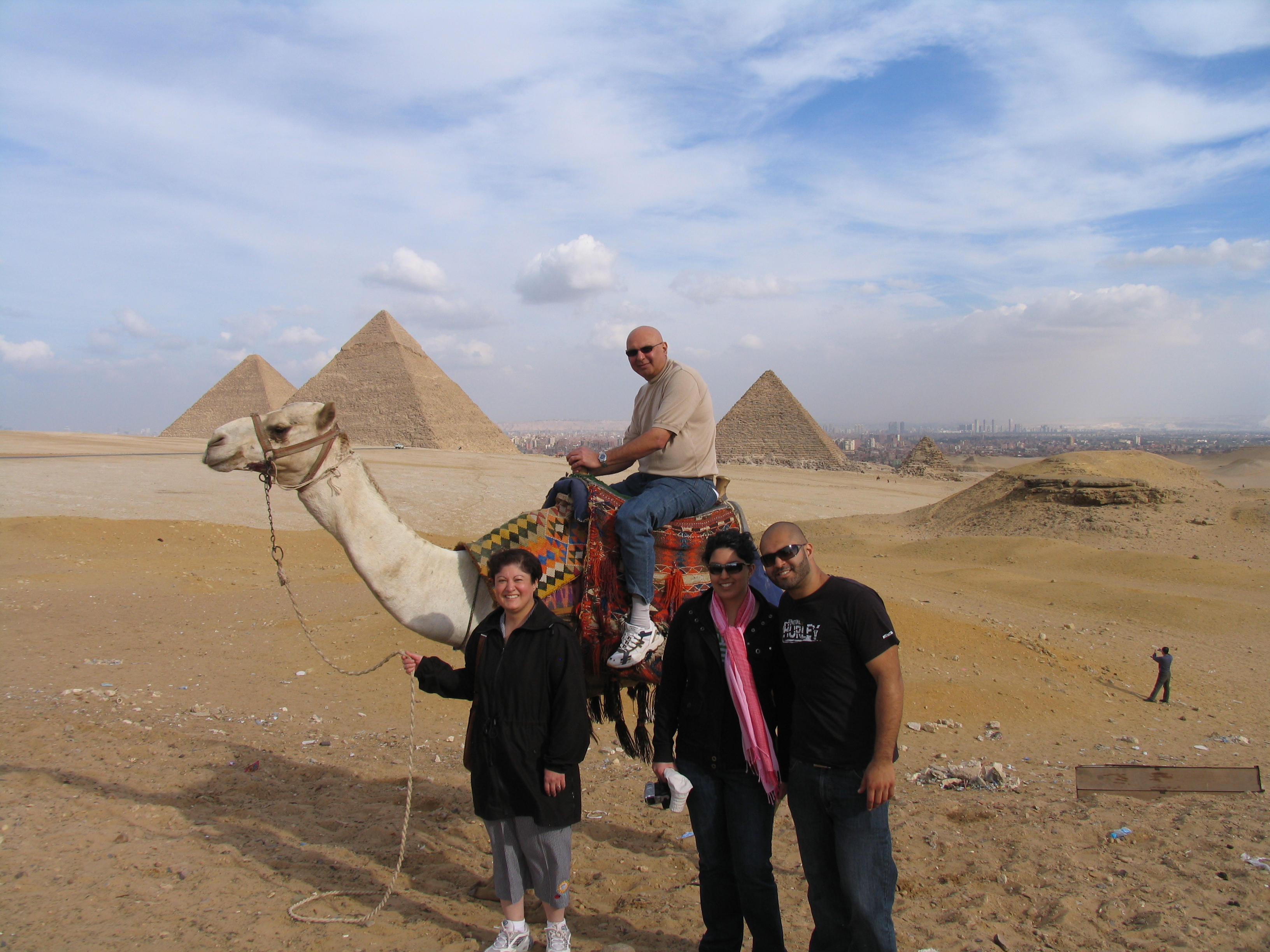
The picture shows Noorali on the camel at the Giza pyramids with Sabiya, Alia and Hussein in the foreground.

Christmas on the River Nile, New Year’s eve party in the land of the pyramids in Cairo and a dance with a belly dancer (with two belly buttons – just kidding) in the Dubai desert on our last day summarizes (in a simple way) our holiday in the Middle East.

International travel has its dangers. We had taken all the precautions to prevent mummy’s tummy and we had our flu vaccination and other vaccinations up-to-date. But the flu virus was every where. Almost every other tourist I met had flu. So, my wife and I fell victim to the devious virus.

Canadians returning from Hawaii and Paris have been down with flu and pneumonia as well. I guess the changing weather conditions, jet lag, cramped airplane seats, poor hygienic conditions of the public washrooms, long days sightseeing, late nights and fatigue contribute to low immunity and susceptibility to flu virus. This is my second bout of flu since I had my flu vaccine. Does it say something about the flu vaccine or my immunity?

Politically, the Israeli assault on Gaza was generating big headlines and street demonstrations but it did not affect us. Security is intense to protect the tourists.

In spite of all the hassles of travel, it is worth taking a holiday. Few days away from the daily grind of work and stress does help our mind and body to recover and get energized. It does not matter what you do, camping, fishing, golfing, skiing or just getting away with a nice book to read in the rocky mountains or to a cottage helps recharge your batteries.

The land of the Pharoes is something out of this world. Most of Egypt’s estimated 82 million people live near the banks of the Nile River, in an area of about 40,000 square kilometers (15,000 sq mi), where the only arable agricultural land is found. Eighty per cent of Egypt is Sahara Desert which is sparsely inhabited.

Cairo has 20 million people. And who knows how many million cars on the road. Driving in the city of Cairo is scary. There is continuous honking and sort of organized chaos in the streets where almost five cars drive side by side in a 3-lane road. Passing each other and changing lanes is like watching a video game except this is real and looks very dangerous. For our taxi driver (30 years’ experience driving in Cairo) it was fun. We used the same guy for four days. He kept on saying, “Drivers in Cairo are crazy.”

We started our holiday from Aswan and Abu Simbel. Then we took a four-night (five days) Nile Cruise which covered Kom Ombo Edfu, and Luxor, the old capital of Egypt. From Luxor we took an overnight train to Cairo (some people prefer to fly). After few days in Cairo we went to Dubai.

Egyptian history goes back over 5000 years BC. In Dubai, the history of development is pretty new. You see how money can conquer desert and water to create a miracle metropolis. Your eyes will not believe what you see. It is like a mirage. This has happened in the last 10 to 20 years. Egypt and Dubai are two different worlds.

People in Egypt and Dubai go out of their way to be nice to tourists. Tourists bring in lot of dollars. Vendors are little aggressive in their sale but you need to learn how to bargain. Tourist guides are all well educated in the history of Egypt. Tourist guides have to go through four years of college and should know at least two to three international languages to be certified as a tourist guide.

We could not see everything in Egypt. There is so much to see. But we visited some of the world’s most famous monuments, including the Giza pyramid complex and its Great Sphinx. We also saw the mummies in Cairo Museum.

Now that 2008 is over with, let us see what is in store for us in 2009. I pray for good health and happiness for all.

Start reading the preview of my book A Doctor's Journey for free on Amazon. Available on Kindle for $2.99!