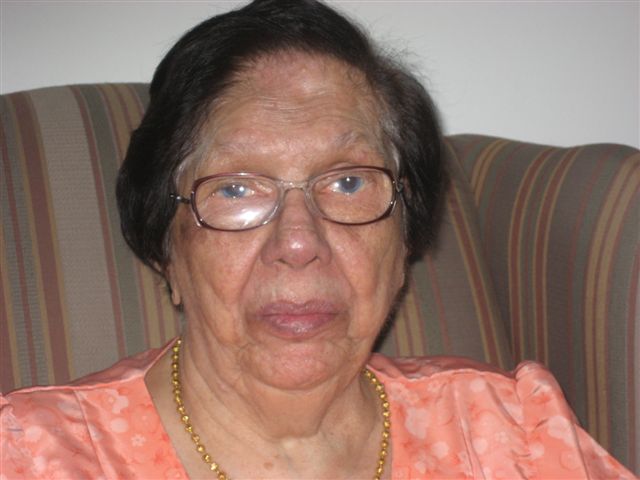
Lives Lived: Sikina Bharwani

Sikina Bharwani
Sikina Bharwani

Wife, mother, grandmother, great-grandmother, great-great-grandmother, matriarch. Born Dec. 1, 1920, in Jamjodhpur, Gujarat, India. Died April 19 in Calgary of metastatic gynecologic cancer, aged 87.

At the tender age of 15, Sikina married a handsome man named Hussein, who was 21. He had worked in Tanzania for eight years and had returned to India to look for a bride. He and Sikina married and lived in Tanzania for more than 35 years. They had eight children.

Sikina faced many challenges in her life. One of them was a motor vehicle collision in 1965. She was a passenger in a cab that was taking her to Masaka, Uganda, when the cab was hit head-on by a drunk driver. Sikina sustained multiple life-threatening injuries with many broken bones. She spent four months in a hospital in Kampala, Uganda. But she fought back and survived.

With Idi Amin’s brutal regime in Uganda terrorizing Asians, Hussein and Sikina decided to leave Tanzania. They moved to England and then to Canada, arriving in Calgary in 1975.

Five years later, Sikina was found to have a brain tumour close to a large blood vessel. Two neurosurgeons in Calgary felt surgery would be too risky. Hussein insisted on a third opinion. The third neurosurgeon, after considerable deliberations, elected to do the surgery. We were warned of the likely complications and the possibility of death. But Sikina was ready for it; she could not live the way she felt.

Sikina survived the six-hour surgery and had a full recovery. After many years of good health, in April, 2000, she momentarily lost speech and function on the right side of her body. A large tumour had recurred at the site of the previous excision.

Within a week, Sikina was back in the operating room undergoing another six hours of brain surgery. This time the recovery was slow. She was in the hospital for five weeks. But she did not give up. She was home again looking better and walking with a walker.
This time Hussein wasn’t there – he had passed away in 1991. But all her children and their families were around.

Sikina also had numerous friends. She was known to be always smiling and never complaining. Out of all things, her courage stands out. She had experienced three life-threatening events, moved through four continents and courageously faced many of life’s ups and downs and survived. She had a Grade 4 level education and spoke very little English, yet she managed to live alone for 17 years in a one-bedroom condo. She was one tough lady.

Sikina believed in God and miracles. She was the matriarch of the family, survived by five children, 18 grandchildren, 10 great-grandchildren and one great-great-grandchild. She is missed by all who knew her. Long live Sikina and her legacy of love, courage and optimism.

Noorali Bharwani is Sikina’s son.

Start reading the preview of my book A Doctor's Journey for free on Amazon. Available on Kindle for $2.99!
Colorectal Cancer Screening Program

Last week, every physician in Alberta received an envelope from Alberta Cancer Board containing Alberta’s first clinical practice guidelines for colorectal cancer screening. There isn’t much new in the protocol they advocate. This protocol has been used before and followed by many physicians in Alberta and around the world. What is new is that the protocol has now been formally accepted and promoted by various health organizations in Alberta.

Number one cancer killer in Alberta is lung cancer. What is the second leading cause of cancer death in Alberta? Of course, colon and rectal cancer. In 2004, 650 Albertans died of this disease. In Canada, 8,700 people died of colorectal cancer in 2007.

How many people over the age of 50 get screened for colorectal cancer each year? Less than 15 per cent. That is not good. Alberta Cancer Board hopes that this number will improve in the next few years.

Asymptomatic men and women who are 50 years or older, with no family history of colorectal cancer, are considered to have average risk for colorectal cancer and one of the following options is available for screening:
-Stool tests, also known as fecal occult blood tests (FOBT), yearly or bi-annually or
-Flexible sigmoidoscopy (60 cm. scope) every five years – checks rectum and left side of the colon. This is an office procedure. It picks up 50 to 70 per cent of advanced polyps and cancer or
-Combine fecal occult blood tests with flexible sigmoidoscopy every five years or
-Barium enema every five years (not used very often for screening) or
-Colonoscopy every 10 years

It is quite reasonable to choose any one of the above methods. This is better than no screening. Each method has advantages and disadvantages which your doctor will discuss with you.

It is of interest to note that Alberta Medical Association’s TOP (Toward Optimized Practice) program has launched Health Screen in Act10n (meaning 10 screening maneuvers) program to enhance screening practices among Alberta doctors.

The TOP pamphlet says that the campaign asks physicians to use a checklist of health markers when seeing patients for periodic health examinations to make sure that they have covered areas of importance which would improve the quality of their practice and enhance patient’s health in preventing disease.

Ten markers or maneuvers were selected were on the basis of best practice evidence available from various sources. These are: patient’s smoking behavior, blood pressure, tetanus/diphtheria vaccination status, PAP test, clinical breast examination, fasting glucose, lipids, mammography, colorectal cancer screening and bone density.

It would not be a bad idea for you to make a list of these markers and see where you stand. Even better would be to take the list with you when you see your doctor next time and see how you are doing. Human memory can be short or deceptive when it comes to remembering dates. Your doctor should be able to help you update your checklist.

It is not easy to stay healthy. It requires time, perseverance and sacrifice. Good luck.

Start reading the preview of my book A Doctor's Journey for free on Amazon. Available on Kindle for $2.99!

Testicular Cancer In a Nutshell

Two things happened recently: a local celebrity went public about his recent encounter with testicular cancer and a pamphlet, published by the Canadian Testicular Cancer Association (TCTCA), arrived in my mail box. I thought it was a good topic to discuss and put the subject in a nutshell (no pun intended).

Testicular cancer is rare but it is the most common cancer in young men between the ages of 15-35, says the TCTCA pamphlet. A young man has a one-in-300 chance of developing it sometime in his life. In the last 30 years, rates in Ontario have increased by 60 per cent. The incidence of this disease has been increasing in developed countries throughout the world for several decades. We should not forget that testicular cancer can occur in older men as well.

According to a document released by Alberta Cancer Board (Cancer in Alberta: A Regional Picture 2007) the incidence of cancer of male genital organs (testicles, scrotum and penis) in 2004, excluding prostate cancer, was 8.2 per 100,000 population. Total number of cases was 124 for all three male genital organs compared to prostate cancer the total number was 1986 (138.8 per 100,000 population). The document does not give a separate figure for testicular cancer. But these statistics give you an idea that the number of testicular cancer is not very high.

Who gets testicular cancer?

There are several risk factors. These are: delayed drop of the testicles into the scrotum at birth, a family history of testicular cancer, abnormal testicular development, some rare genetic condition or one testicle is significantly smaller than the other. But some men get the disease with none of these risk factors.

Early detection of cancer is important. And this can be done by self-examination after a hot shower when the scrotum is completely relaxed. Check for any swelling on the scrotum. Examination of the testicles should not be painful. You should feel the size and weight of each testicle. It is common for one testicle to be slightly bigger than the other and one may hang lower than the other. Examine yourself at least once a month.

What are the signs and symptoms of testicular cancer?

If you notice any change in size, shape or consistency of the testicle then you should talk to your doctor. Quite often (but not always) there is a painless hard lump. You should be concerned if there is any swelling or pain in the scrotum, if you notice any heaviness or dragging in the lower abdomen or scrotum or a dull ache in the lower abdomen and groin, unusual backache that doesn’t go away or you have unexplained weight loss. Any soreness or sudden unexplained enlargement of the breast should be checked out. It could be secondary to testicular cancer. TCTCA warns that some males get testicular cancer without any of these signs or symptoms.

First line of investigation for a suspected lump in the scrotum is an ultrasound. If cancer is suspected then additional blood tests are done to look for tumour markers. The tumour markers for testicular cancer are AFP (alpha-fetoprotein), beta-HCG (beta-human chorionic gonadotropin) and LDH (lactate dehydrogenase).

A definitive diagnosis of testicular cancer is made by removing the testicle and sending it for biopsy. Then the cancer is checked for any spread to lymph glands or other organs. Treatment may include surgery, radiation therapy or chemotherapy. The cure rate for testicular cancer is greater than 90 per cent for all stages. In men, whose cancer is diagnosed in an early stage, the cure rate is nearly 100 per cent. Even those with advanced disease have a cure rate of greater than 80 per cent.

For more information visit: www.tctca.org.

Start reading the preview of my book A Doctor's Journey for free on Amazon. Available on Kindle for $2.99!

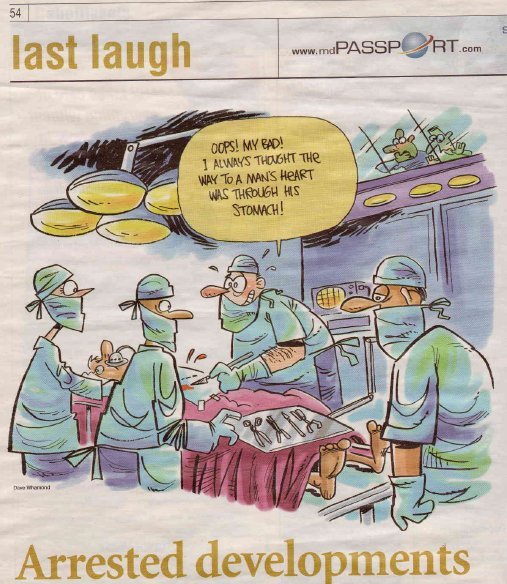
Last Laugh: Arrested Developments

Dr. Noorali Bharwani comes to the awkward conclusion that as a surgeon he has certain skills but as for the general doctoring skills others seemed to have-uh, not so much.

Cartoon from article in Medical Post.


When it comes to cardiac arrest, we, the surgeons, do not get any respect.

When it comes to severe trauma, a general surgeon is expected to be “captain of the ship” and take command of resuscitation and stabilization of the patient. This is because we know the first three letters of the alphabet: ABC (airway, breathing and circulation).

When I was a general surgical resident, I was not part of the cardiac arrest team. I confess, beyond ABC, I have difficulty remembering what to inject and where to inject drugs during cardiac arrest. Should they be given subcutaneously, intravenously or intra-cardiac? What does the ECG say? I can read a flat line (by that time it is too late anyway) but I would have trouble interpreting anything else.

I am not totally useless. I can intubate a patient, perform a tracheotomy, do a cut down on a vein and place an arterial line. Beyond that my medical knowledge is not that strong.

I was beginning to develop a complex. I was jealous of the internal medicine residents who acted so smart. Their white coat pockets bulged with concise pocket guidebooks, hammer, tuning fork, flashlight, different coloured pens and a stethoscope hanging down their necks. They would know the precise dosage of medications and would know exactly what to give at what stage of the cardiac arrest.

In order to regain my confidence and self-esteem, I decided to do three months’ elective in ICU as part of my surgical residency program.

Word of my limited knowledge of cardio-respiratory medicine must have reached the medical staff of ICU because the only procedures I was assigned to do were tracheotomies, intubations, cut-downs for venous excess and insertion of an arterial line.

This further exasperated my frustration and low personal esteem. It did not get any better when I went into practice. One day, I had done a right hemicolectomy on an elderly patient. Within the first couple of days after surgery, he developed severe chest pain and went into cardiac arrest. This was about two in the morning. The nurse phoned me to say the cardiac arrest team was there to resuscitate the patient and she was letting me know what was going on. She said the ER physician was dealing with the cardiac arrest.

I felt guilty that I wasn’t there to be “captain of the ship” and save my patient’s life. By the time I dressed and rushed to the hospital the patient had died. I could see the straight line on the ECG, the pupils were fixed and dilated, he was not responding to painful stimuli, he had no heart or breath sounds. Like a true captain I called off the resuscitation process.

Last summer, I was on a transatlantic flight with my family. I was trying to relax with soft jazz music beaming through my earphones. Suddenly the music stopped and I heard the captain say: “This is the captain speaking. Is there is a doctor or a nurse on board? Please identify yourself.”

I was reluctant to identify myself knowing my limited capacity when dealing with medical problems. At the request of my family, and not wanting my children to see me being a wuss, I pressed the overhead button. The air hostess came.

“I am a surgeon. Is there anything I can do to help?” I asked.

“Oh, don’t worry,” she said. “We don’t think the lady needs any surgery. She is having chest pain and is short of breath. We found a nurse. She is managing the case quite well.”

Although I was relieved to hear everything was going well without my services, I wondered what would have happened if my services were needed. Would I have failed to save somebody’s life?

That question weighed heavily on my chest (no pun intended). I started to get nightmares. In my sleep, I would recite the protocol of managing cardiac arrest. One night, my wife shook me and woke me up. Apparently, I was trying to give her mouth-to-mouth resuscitation while massaging her chest. She said I had been doing that every night since we got back from our holidays. Except, this time I was getting a little too excited!

“Honey, you don’t have to be that rough. If you want something then just ask nicely,” she said.

Why didn’t she say that before?

Start reading the preview of my book A Doctor's Journey for free on Amazon. Available on Kindle for $2.99!