Hypertension

“Hypertension is a growing concern in our society. The increase in the prevalence of this condition is in part related to changes in levels of physical activity and diet and increases in obesity and the average age of the Canadian population,” says an article in the Canadian Medical Association Journal (CMAJ).

Why should we worry about hypertension?

Hypertension (high blood pressure) is a silent killer. One may have high blood pressure but have no symptoms. It silently causes damage to our vital organs and eventually results in heart attack, congestive heart failure, stroke, kidney failure and blindness.

It is estimated that 25 percent of the 42 million people with high blood pressure in the United States are unaware that they have high blood pressure and approximately three fourths of those with known hypertension have blood pressure that exceeds the recommended level! This is dangerous!

What is the normal blood pressure?

Normal blood pressure is defined as systolic blood pressure of less than 140 mm Hg (mercury) and diastolic blood pressure of less than 90 mm Hg. It is written as – systolic over diastolic (for example 120/80 mm Hg).

Blood pressure is lowest in the early morning, rises as the day progresses, then dips down during the night and earliest hours of the morning, says another CMAJ article.

Blood pressure also varies from minute to minute, depending on levels of stress and physical activity, as well as other determinants of cardiovascular activity.

“White-coat hypertension” means a person’s blood pressure is up in the doctor’s office but not elsewhere.

Why do people have hypertension?

Hypertension affects 22 percent of Canadians. The incidence of hypertension increases with age. Most elderly Canadians have high blood pressure – probably due to thickening of blood vessels. No cause is identified in 80 to 95 percent of people with hypertension.
This is known as idiopathic or essential hypertension. Others have hypertension due to primary disease of kidneys or due to certain hormonal disorders.

What can we do to prevent and control hypertension?

Hypertension can be prevented and/or treated with lifestyle changes – with or without medication.

Here are some suggestions: eat a healthy diet, lose weight if you are overweight, do not smoke, limit alcohol intake, eat a low salt diet, do regular exercise – three to five times a week, relax and learn to manage stress with laughter and meditation.

An article in the New England Journal of Medicine states that in general there is poor control of hypertension as 50 per cent of the patients with high blood pressure discontinue their antihypertensive medications by the first year. There are many reasons why this happens. But this is not good. It is dangerous.

Now, here is something for your Thursday morning smile – written by an unknown author:

It’s sad for a girl to reach the age
Where men consider her charmless,
But it’s worse for a man to attain the age
Where the girls consider him harmless.

So, let us be careful about our blood pressure before it makes us charmless, harmless and worthless!

Start reading the preview of my book A Doctor's Journey for free on Amazon. Available on Kindle for $2.99!
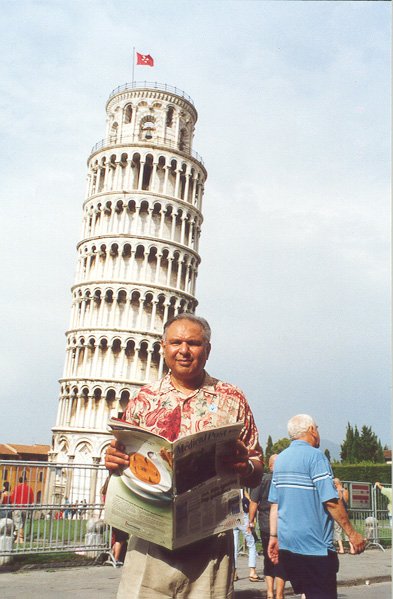
Leaning Tower of Pisa

Damn cheap architects!

In July/August, I went to Europe with my family. We visited London, Oxford, Paris, Geneva, Venice, Florence, Pisa, Rome and Vatican City.

It was interesting to visit the Leaning Tower of Pisa. Its construction began in August of 1173. It took about 200 years to build with couple of long interruptions. Towers inclination started when the third floor was built – it has eight floors. In the last couple of years, steps have been taken to reduce the inclination. It is again open to public. The tour guide told us that it is now good for another 300 years.

The more I looked at the Tower the more it reminded me of our health care system. It has been in crisis since I joined the system 17 years ago. Like the Tower, the health care system is expected to collapse anytime but continues to survive with lot of band-aid solutions and Royal Commissions. I would not be surprised if it outlasts most of the present generation of doctors.

Start reading the preview of my book A Doctor's Journey for free on Amazon. Available on Kindle for $2.99!

Battle of the Buldge

Battle of the bulge continues for 50 percent of the Canadians!

Some months ago, I wrote about my own ever increasing girth and my struggle to lose few pounds. I received the following advice from one of the readers:

“It is my experience with ever increasing girth and the reduction of, to eliminate all things white, e.g. white flour, white rice, white fat (turns white when cold and solid), and white sugar (both refined and artificial). I quit sugar to eliminate my migraines (it worked) and lost 34 lbs. in a year. Hope it helps. Good luck, if you try it, that is.”

A good piece of advice.

Losing weight takes time. This point was driven home to me by a cartoon I saw in one of our humor magazines. A kid asks his friend, “How come your mom is so grumpy?” The friend replies, “She’s been on a diet for a month and all she’s lost is her patience.”

You probably remember the story of Melodie Garland published in The Medicine Hat News in May. The headline said: Determination and commitment leads to weight loss success. Garland lost 75 lbs in over a year with a strict diet and exercise. She also attended a local support group.

An article in the New England Journal of Medicine (NEJM) says, “Although 29 percent of the men in the U.S. and 44 percent of the women describe themselves as trying to lose weight, only about 20 percent report restricting caloric intake and increasing physical activity simultaneously, despite recommendation indicating that this combination is effective.” Well, Garland falls in that 20 percent group. She did the right thing.

What else?

In June, the Medicine Hat News wrote a story about the work done by my general surgical colleague, Dr. Carl Nohr. The article had a headline: Winning at the losing game. Nohr does gastric by-pass surgery. His patients lose more than 100 lbs rapidly and are extremely grateful to him for giving them their life back.

In the article, Nohr warns that surgery is not without risks. He says, “People who have a bypass have no protection against being overweight anymore than you and I. This is not a license for people to eat any amount or whatever they feel like. It is more a way of giving them a chance to be like an average person.”

What about pills? No magic pills to lose weight? None.

Obesity is a multi-factorial illness, says Nohr. It is a blend of genetic, metabolic and environmental factors. It is notoriously difficult to treat. There is no one magical solution to obesity. Which ever method or program you chose, you have to work hard for every pound you lose. And have to work harder to maintain the weight loss.

Losing weight isn’t easy but it can be done. Go on a diet (reduce income), exercise regularly (be a big spender), have determination and commitment, give it a good try and be patient. If it does not work then join a support group.

If that does not work then see a psychologist or psychiatrist for behavioral treatment. If that fails then see Nohr. If he accepts you then have bypass surgery and continue with diet, exercise, determination, commitment, patience, and try and try again………….. Winners never quit and quitters never win! The battle goes on!

Now, where is my mirror? And get me Dr. Nohr please!

Start reading the preview of my book A Doctor's Journey for free on Amazon. Available on Kindle for $2.99!

Quitting HRT

Couple of weeks ago, we published a column on hormone replacement therapy (HRT). The column reported on Women’s Health Initiative (WHI) trial. The trial was suddenly stopped because it was found that HRT (estrogen and progestin) in post-menopausal women was responsible for:

-41 percent increase in stroke
-29 percent increase in heart attacks
-doubling of rates of blood clots in the legs and lungs
-26 percent increase in breast cancer
-22 percent increase in total cardiovascular disease.

But, it also said that HRT has benefits:

-37 percent reduction in cases of colorectal cancer
-33 percent reduction in hip fractures
-no difference in total death rate from all causes
-controls hot flashes

After reading that column, a lady wrote:

“I have been on HRT for around eight to 10 years, and after reading your column in the paper, I totally stopped using the HRT.”

This lady was scared that now she is off HRT she will get “emotional problems” and she had started to get hot flashes. She was worried because she could not get to see her doctor for three weeks!

My advice in the column was simple – DO NOT STOP TAKING HRT WITHOUT DISCUSSING FIRST WITH YOUR FAMILY PHYSICIAN OR GYNECOLOGIST. If one is on HRT for 10 years then waiting three weeks to see a doctor is not going to make anything worse.

I was also told by Dr. Robert Woolf that women who need HRT should look into natural hormone replacement therapy. Woolf is a family physician in Medicine Hat who also practices alternative or complementary medicine. The natural hormones are derived from plants.

What is the safety and efficacy of the natural hormones over a long period of time? NEWSEEK reports that the National Institutes of Health is now supporting a trial to test two herbs for post-menopausal symptoms. So far, researchers have found no side effects, but they will continue to monitor women for changes in the breast, uterus and bones. Results will be keenly awaited.

What should post-menopausal women do now?

Last week, the Canadian Society of Obstetricians and Gynecologists (SOGC) released guidelines for HRT use in response to WHI trial. Here are the main points:

-If you have been on HRT for more than five years then talk to your physician whether you should continue
-Do not be overly concerned if you have been on HRT for more than five years – danger to an individual woman is small
-If you need to be on HRT then take the lowest possible dose for the shortest possible time – probably not longer than four years
-97.5 per cent of women, out of 8000 in the WHI study, had no adverse outcomes
-If you have been off HRT for five years then the risk of cancer drops to zero
-These guidelines apply to women who are on combination therapy of estrogen and progestin.

If you are on HRT then there is no need to panic. Discuss your options with your family doctor or gynecologist. There is more than one way to stay healthy and happy.

Start reading the preview of my book A Doctor's Journey for free on Amazon. Available on Kindle for $2.99!